


The first impression of Delhi, the capital of India, when you arrive is that it is a hectic city with almost 10 million people continuously moving, provoking constant traffic jams in the main roads. When you arrive there, you may be prone to get immersed into the city, and decide to walk to the closest spot from your hotel. We did that too, and those were the worst 2 km that I have walked in a long time. My first recommendation would be to avoid doing that: Delhi (and in general, India) is not thought to have people walking long distances. Instead, take its wonderful subway, you will be pleased with its modern network, and its tidiness.

If you happen to stay near the diplomatic area, your first stop is the Gate of India. It reminded me to the Puerta de Alcalá, but in a nicer promenade made to emphasise the presence of the Parliament. If you are there after the sunset, you will find a hectic environment: local tourists taking themselves selfies with the monument (hard with the light conditions), and some others offering all kind of services (pictures, water selling, sweets, …). The building might not impress you much, but the leisure atmosphere is a nice beginning.

From there, you can would head to Connaught Place, another particular spot of the city: well known brand (and expensive) shops, tons of restaurants and bars, bazaars in the street, and mostly young people make it the top destination for evenings out, and some decent -but expensive- shopping.

The real visit to Delhi starts with Old Delhi, and there the main attraction is the Red Fort: the first fort in India was also one of the biggest in the country, and if you started your trip now, you will enjoy this kind of palaces (after a few more, you may be looking for something else): a fort is a sort of palace with military defences. Forts are a good way to understand the aesthetic taste at different ages in the history of India, and you can imagine the rulers having their receptions or living there, walking like we can do now in their vast and well preserved gardens.

When you go out of the fort, crossing a busy bazaar, you will arrive the the Jama Masjid, an impressive mosque, able to host up to 25000 people. If like me, you find mosques captivating with their vast open spaces, you can enjoy its atmosphere of retreat, so needed even if it is only the first day in Delhi. You might be luckier than we were, and have a successful visit to the nearby bazaar and the spice market… We did not enjoy it much. Either we did not go to the right place, or my expectations were not the right ones. Bazaar and spice markets bring me to two places in this world: Istanbul and Marrakech, and that was not what we saw there.

To complete the day, you can visit two wonderful monuments; both of them are memorials of different rulers. The first one is the Safdarjang’s Tomb, and as it is not in the centre, it is not crowded, and its visit becomes a relaxing experience, where you can even take a short siesta to recover from the jetlag. The second one was the Humayan’s tomb, which is almost as crowded as the Fort. This memorial inspired the Taj Mahal in Agra, and it is a huge red marble building with several tombs inside. Taj Mahal is a clear must, but visiting Humayan’s tomb boosts the appetite to arrive to Agra.

Before the sunset, you can still be convinced by a crazy tuk tuk driver to go to the Lotus Temple, a modern building in the outskirts of Delhi, which hosts the Bahai House of Worship, aiming to close the gap between different religions… Not that interesting inside (a few minutes to reflect, pray, etc.), but really nice from the outside.

A great farewell from Delhi can be the Loddhi Park and buy some curry and tea. The park atmosphere was very similar to the one you can see in any big park in the world: my dear Retiro park in Madrid, Englischer Garten in München, Central Park in New York, with only minor differences (like the remains of a mosque inside): people jogging, couples, friends, and even BBQ’s… Life in megacities are the same in any place in the world: we are not that different in the end.


India is synonym of chaos. Although they manage to keep the airport calm by not letting in anyone not travelling, once you get out of there, your survival instinct makes you observe of all details of the intense and diverse traffic.

There are old and new cars, decorated trucks, thousands of motorbikes (some of them with up to 4 people), the tuk-tuk’s or rickshaws which will soon become your favorite mean of transportation, the tough cycle rickshaw… You realize soon there is more life than pedestrians and vehicles…

Animals are also all around: not only dogs and cats, but also cows, goats, donkeys and porks are present in the streets, playing their role in this organised chaos. This diversity is in constant movement in flexible paths, where right, left, forward and backward become elastic concepts, as lanes are just recommendations. After a few days, you will not remember, that your first minutes you were constantly wondering why everybody is using their horn all the time.


Your focus will also turn towards those animals that walk free: pigs, dogs and even monkeys can be found in any corner of a city like Delhi. You see goats carried on rickshaws and motorbikes by their owners, and sacred cows with a not very healthy aspect, anywhere you can think of.
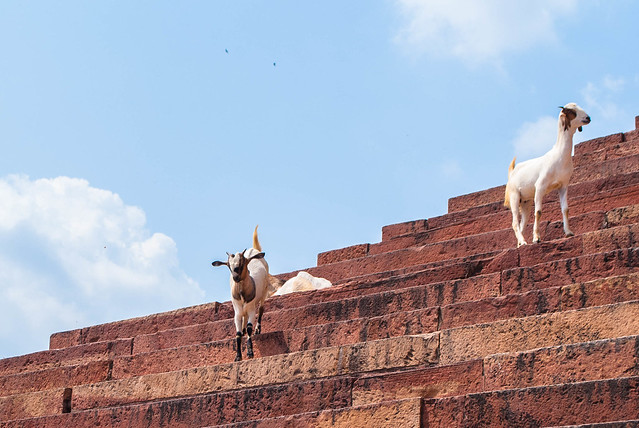

You even see cows walking on the railroad in a train station.

The sacred condition of the cows make them especially popular in the streets, and vehicles respect them completely, and you think that would not happen back home. A driver will explain you why they are seldom crashed by a vehicle: in such a case, driver would have to pay for any damage, and as it is an important sin, he would need to go to the Ganges to get purified, he would need to pay the brahmins (priests) for some prays, and most importantly: your family would belong from that moment to the lowest caste. Too high price.


Caste system is still present and alive in India, and it does not seem about to change in the short term. This makes some extreme poverty be present, especially in big cities. There are people begging in the streets, and the health standards are way below those you are lucky enough to have at home. The presence of animals living freely in the streets, garbage in any unexpected place, water not being potable makes the living conditions not the most adequate ones. Development is not equal throughout the country, and rural areas still show women walking several kilometres to the nearest source of water, to carry it back home.

Once you start getting used to the chaos, you will look at the people and find out the interesting mix in way of dressing that you find, mainly driven by the several religions present in India. Most of them belong to the Hinduism, muslims follow them (although the most muslim areas in the region are now independent from India -Bangladesh and Pakistan), and then the sikhs with their colourful turbans make them very visible.

When you start getting hungry, you start the challenging task of identifying in the menu, those dishes that you will like the most. A wrong choice can make your mouth be on fire for hours, as they like veggie and specially spicyfood. You take special care with the drinks, always choosing something bottled, and decide not to pay attention to the non observance of some hygiene procedures that are standard at home.
Prices will make you remember why India is one of the main manufacturing countries in the world: they are lower than anywhere else that you have been before. In any case, they recognise the tourists easily and offer them higher prices -still affordable-, and even the government has “prices for foreigners”. You will soon realize that you are an easy target for all kind of scams, even if you try to your eyes wide open: the most popular one is that any transport you take will make you stop in a shop/restaurant where they get a certain commission from any spend you have.

You have an overall idea of India. Ready to live it?
El pasado puente de Todos los Santos (1 de noviembre), nos volvimos a embarcar camino de Ibiza, en lo que sería el cierre de la temporada náutica de 2016. Esta travesía totalmente “fuera de temporada” tiene sus ventajas y sus inconvenientes.

La ventaja está clara: la cantidad de embarcaciones en las calas de Ibiza es infinitamente menor, por lo que se puede disfrutar de la isla en su plenitud. Además, el tiempo, que era un riesgo importante, nos respetó dándonos los últimos 4 días de calor tal que permitiera bañarnos.
La desventaja, en cambio, son las pocas horas de luz, que nos hicieron modificar los planes, especialmente las travesías, ya que no hay horas de luz suficientes para hacer Alicante-Ibiza, así que optamos por travesías nocturnas. Es curioso también que, de forma natural, la falta de luz fuera (y las bajas temperaturas nocturnas), nos hacía recluirnos dentro y acabábamos teniendo horarios bastante alineados con la luz solar. Una vida bastante “slow” para lo que suele ser habitual.

El viernes noche, una vez llegó toda la tripulación, fijamos los pertinentes turnos de guardia, y partimos del Puerto de Alicante con un rumbo paralelo a la Costa Blanca para minimizar las horas en las que estaríamos lejos de la costa, virando a la altura de Calpe hacia Cala Saona, en Formentera. La travesía fue bastante apacible, reseñando sólo un par de cargueros que pasan por el Separador de Tráfico que hubo que librar adecuadamente.

Llegamos a Cala Saona justos para comer, darnos un baño, y confirmar que teníamos la isla prácticamente para nosotros solos. La última vez (junio) que estuve en Cala Saona había cerca de 40 barcos y, esta vez, sólo 4.

Por la tarde, enfilamos hacia la Isla de Espalmador, donde pasaríamos la noche fondeados en una boya. En este trayecto contamos con un poco de viento de través que nos permitió incluso quitar el motor un rato. Por la mañana pudimos hacer una pequeña excursión a tierra para ver si había algún resquicio del incendio del verano, y donde fuimos atacados por mosquitos hasta la saciedad.

De Espalmador, partimos hacia Tagomago en un día con total ausencia de viento, por lo que desayunamos en travesía. Toda la costa desde Ibiza hasta Tagomago era una zona totalmente nueva para mí y la cala SW de Tagomago fue todo un descubrimiento porque el fondeo es muy agradable (al menos en estas fechas!). Además, en su cercanía hay siempre delfines, y pudimos ver unos cuantos nadando muy cerca de nuestro barco. Los delfines siempre es una buena forma de redondear una salida náutica.

Después del baño y la comida, emprendimos la vuelta hacia el puerto de Ibiza, que era nuestra única noche en puerto. Siempre está bien tener un día de asueto, tomarse algo en tierra, y en mi caso, aprovechar para visitar a Paloma y Laia, su recién nacida hija. Además, aprovechamos para visitar Dalt Vila, la parte alta de Ibiza, y la más interesante turísticamente, ya que buena parte de la tripulación no la conocía. La marina que elegimos para atracar fue Ibiza Magna, cuya ubicación es perfecta, porque estás ya en el propio casco antiguo, pero que también tuvo inconvenientes: las duchas estaban en obras (i.e.: no había) y los ferries movían bastante el barco. El Puerto de Ibiza no estaba tan animado como en verano, pero pudimos ver el Prince Abdullaziz, el barco de la familia real saudí, que pasa los veranos en Ibiza junto a sus propietarios y su séquito.

Tras Ibiza, el objetivo era emplear el día (el último en las Islas), para navegar en dirección Este. Así cruzamos el Freu Petit (el día era muy tranquilo), navegamos por Ses Salines, donde pudimos ver un barco cargando sal, y proseguimos a Cala Jondal, famosa por albergar el famoso Blue Marlin. Sacamos la auxiliar, y nos acercamos a tierra a tomarnos una cerveza Isleña, cuya botella es, en sí misma, un souvenir ibicenco. Tras el baño, la comida, y una ronda de cócteles, nos dirigimos a Cala D’Horts, para ver uno de los atardeceres más espectaculares de Ibiza, y para descansar un poco antes de emprender la travesía de regreso a la península.

Tras el atardecer a las 6, decidimos zarpar hacia la península las 8, para poder aprovechar un poco del día siguiente. Así, una vez libramos Es Vedrà, pusimos rumbo directo a Tabarca. Nuevamente hicimos turnos, y precisamente cuando me desperté, había tenido lugar una de las anécdotas del viaje. Antes de subir a cubierta, miré el GPS, y vi que estábamos navegando en dirección Norte. En el mapa, de hecho, se puede ver ese cambio de rumbo. ¿La razón? Parece que habían maniobrado para dejar pasar a una embarcación de recreo… de 500 pies, que navegaba en dirección Sur. Al recuperar cobertura de móvil, comprobamos que el barco en cuestión era el Eclipse, el segundo barco de recreo más grande del mundo, propiedad de Abramovich, y dotado incluso con misiles.
Con la llegada a Tabarca, un último baño, y rumbo directo al Puerto de Alicante. Se acabó lo que se daba. 5 islas (Formentera, Espalmador, Tagomago, Ibiza, y Tabarca) en 4 días, y baños todos los días. Sólo habríamos pedido un poco más de viento, pero tampoco hay que abusar.