


The Terracotta Army is the main reason for going to Xi’an, but most of us take another day to visit the rest of the city. One of the main spots of this city is the complete wall surrounding the old city, and with a total length of 12 km. They are also open for the public to walk or ride a bike on them.

Apart from that, I liked the Big Wild Goose Pagoda in the south of the city, and the Drum Tower, an impressive building in the center of the old town. The Drum Tower was normally placed in the center of the ancient chinese citiies, together with the Bell Tower, and were used to announce the time.


I found also people in Xi’an quite more talkative and funnier than in Beijing, and even more English-speakers. Of course, I guess the fact that there was some festival happening in the city on December 25th night helped me in having a nicer feeling about the citizens.

But what I did not like at all, and will be difficult to forget about, is the pollution. In Beijing there was also pollution, but not at Xi’an’s level.


An image is worth more than one thousand words, but I will say that at any time, you could actually see the pollution at a few hundreds meter distance from you. Just amazing, but easily understandable after seeing from the train or the bus the heavy industrial area around the city.

Pollution is one of the hot topics China should focus on. It is well known in the world the issue with the pollution, and it has appeared in many occasions in the news, like its impact in the Olympics, but they really need to do something with it… for the planet, but mainly for the Chinese. It cannot be healthy when you actually feel and see you are breathing pollution.
Right after Beijing, I took a night train to Xi’an. In China, it is very common to find night trains between main cities, and it is a very convenient way of travelling for many reasons. You do not need to got the airport (normally far away from the city centre), you can sleep reasonable well, you do not need to sacrifize afternoons in going to the airport, and waiting times and so on, as the train departure is in the evening… And it is cheaper, and you save some accomodation nights. 🙂


Any way, I got to Xi’an. You might not know what Xi’an is, but it is one of the ancient capitals of China, and is now hosting one of the most important archeological treasures in the World: The Terracotta Army. This is important not only for the size of this army: more than 6000 thousand soldiers and horses, but also because of the quality of each sculture, and their uniqueness: there are not two equal soldiers. Each one has a different face, so the amount of work needed for this is even bigger.


I wondered what the origin of this army was, and here we meet again with our friend Qin Shi Huang. I wrote about him in the previous post about the Great Wall. He did lots of good things… and he also loved himself too much, apart from being afraid from death. So, as he was soooo great, even his tomb needed to be protected by an army… I guess he realized that maybe such a large army could not be a real one, so he created a fake one.


This army was found in the 60’s by some farmers from this area, and the excavation works are still on going in the three different buildings covering this amazing finding. It can be fully visited and lies a couple of kilometres from the actual tomb of the Emperor they are protecting…
Call me stupid if you want, but I would not be surprised if this is just a small part of the army..
This is probably the best-known spot in China: The Great Wall. It lies in the north of Beijing (around one hour by bus), and it is the combination of several smaller defensive walls, which the first emperor of China, Qin Shi Huang, who was as brilliant as tyrannical and megalomaniac. He was the first one who unified China, and who reformed it, and also got a lot of improvements for the country…

He also started joining different defensive existent walls one to each other, to protect China from the Mongolians from the North. This work was followed by other emperors for centuries, and according to Wikipedia, a couple of millions died during this work… I believe it. Take a look to the place where it is located: in the middle of no where, in the highest point of a hilly area, and following the slope…


When walking on it (and take into account that I went to the touristic part, which has been kind of repaired and prepared for the tourists), you sometimes face really tough slopes where you almost need to use the handrail (did I say it was prepared for tourists) to go up, and you definitely need it when descending, if you do not want to roll down…

And, of course, Beijing Olympics were also present there… China is very proud of having organized this event, and you see many referrals to it all around China: squares with sculptures, flags, logos, etc. The slogan here fits quite well with the environment: Qin Shi Huang could have chosen it himself: One World, One Dream.

After the Forbidden City, I took a taxi to go to the Summer Palace, which is quite far from the centre. This is probably the spot which surprised me the most in Beijing in a positive way, as I did not expect it.


It is a huge area in the northeastern part of Beijing, dominated by a big lake, and surrounded by nature and some small hills. A real relaxing place, which probably delighted many chinese emperors in the past.


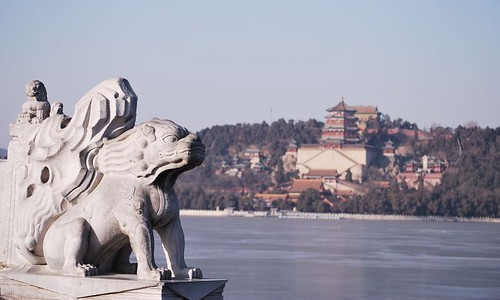
For good and for bad, I went in Winter, so once again I did not suffer crowds of people, but on the other hand, the lake was frozen, and one would not sit down for a long time to enjoy the “fresh air”… 😉


When entering the Forbidden City in the cold morning I visited it, I was surprised by these young soldiers being trained in some martial arts, and forming ranks. I am still wondering why they were doing that there, and not in a closed place with not so many tourists… Yes, I know, maybe those tourists were the main reason for doing that there…


