


Not being long enough in Ireland is a safe way to make a wrong decision. If you decide to explore the Northern part of the island, you will miss the South. If you go to the South, you will leave aside the fantastic North.Our wrong decision this time was to explore the North during Easter holidays (in 2014… some posts take longer than expected!). 🙂

Ireland is an island which is divided in two different countries. The Southern part is the Republic of Ireland, which is a country in the Euro zone, using the metric system (i.e., kilometres) and mostly catholic. Northern Island is part of the United Kingdom, using British pounds, the imperial system (i.e., miles) and with a strong division of protestants and catholics in their population.

This is the outcome of a number of historical happenings. All was initiated with Henry VIII, who wanted the divorce and founded a religion that accepted it. In the 17th century, England sent a Scottish King to the Ulster region, who also “imported” protestant Scottish peasants to the nowadays Northern Ireland. Ireland joined England in 1800, and all their representatives in the Parliament had to be protestants (or say so, at least). In 1916, the Easter Rising ends up with a Free State that led to today’s Republic of Ireland. The population that remained in the North are a mix between the original catholics from several centuries ago, and the protestants that populated the area around 200 years ago. They do not get along very well, and have been fighting ever since.

We had three bases in Ireland during this trip: Dublin, Londonderry and Belfast. The first one is obvious and recommended in any trip in this area, as it is a living city with lots of entertainment opportunities… although you should pay attention if you go in Easter with some closing days; the second one was very convenient to explore the Northernmost coast, and we though Belfast would be similar to Dublin… but it is not.

Newgrange (A) was my first excursion in Ireland. It is a set of constructions, from the Neolithic that were discovered by chance in 1699 when they were removing stones to build a road. There are 37 satellite tombs (with more than 100 people) around the main one, which hosts remains of five people. This construction took three generations to be built (note the life expentancy by then was less than 35 years) and it is quite surprising that the material used (white quartz) was brought from a distance of at least more than 80 kilometers. The main tunnel, which has several curves, channels the sunlight to a specific point in the centre of the tomb only during the solstices. If you are not impressed yet, let me remind you that Neolithic was 10,000 BC.

Dublin (1) is a must in Europe for a relaxed weekend trip. A very intense city thanks to its university, with its fantastic Trinity College, hosting one of the most beautiful libraries in the world, and some of the oldest books in History. Their pubs are also worth a visit… or that is what I heard because they are all closed in Easter Thursday (yes, that was our “Dublin day”).


LondonDerry (2) (or Derry, depends on what are the speaker’s political views) does not have a lot to see. Some murals remembering the Bloody Sunday and the Troubles, and a fortress, but it was a good place to start our journey through the Northern coast of the island. In this coast, we visited Portstewart, the Dunlace Castle (great location) (B), and the Giant’s Causeway (C), a geologic formation formed by basalt columns that were formed after a volcanic eruption got in contact with the water.


Belfast (3) was for me the biggest deception of the trip. We thought it would be nice to sleep in a big city, as it would have more life than other places, but we did not see any life there. Maybe the day (Sunday in Easter) was not the best one too. From the visitor point of view, Belfast is known for hosting the shipyard where the Titanic was built, and for the sadness of having the conflict between catholics and protestants still alive. The two neighbourhoods are still separated by a wall, which have several gates, that are closed during nights and on special days (Easter Sunday, for instance) to avoid more problems.


[AFG_gallery id=’12’]
Sometimes, work makes you stay some days in places where you would not normally go at all. This was the case of my visit to the Perak region in the north-west part of Malaysia.

Malaysia climate in Summer is quite tough: very hot, and very high humidity. In my first visit to Malaysia (months before), I had the impression that Kuala Lumpur was a city in the middle of a rainforest, and that impression became even more true when travelling to a town, where palm trees and dense vegetation are literally across the street.

Palm trees plantations are a very profitable business, and there are plantations along the roads, with a big sign indicating the company exploting each of them, being Sime Darby the main one. Palm trees yield fruit twice a year, which is used for oils, soaps, and other derivate products, sold with a very high margin.


Malaysia has a particular mix of ethnic groups and religions cohabiting, with a surprising very low degree of overall social conflict. Half of the population are Malay, a quarter of them are Chinese, and the Indians are also broadly present. In terms of religion, muslims, buddhists, christians and hindus have a significant percentage of the population.

During this business trip, I had one day off and the only interesting option I was offered was to go to “Pangkor Island”, a paradise island with frequent ferries from a port near my hotel. I “decided” to go, and once there asked a taxi driver to take me around, resting afterwards in one of those “movie” islands, and almost empty. I regret of having asked to drive around the island, because I saw a dumping site next to the sea and, although it was in the opposite side of the island, I did not enjoy swimming in the hot, as much I might have done so.

[AFG_gallery id=’6′]

Salamanca is one of those cities that are a perfect match for a relaxed weekend trip from Madrid. It has a population of roughly 150,000 and 40,000 of them are university students. Its university is the most ancient in Spain (since the 13th Century) and a number of prominent linked to the Literature have lived for some time in this city, like Miguel de Cervantes (Don Quixote), Fernando de Rojas (La Celestina), or Miguel de Unamuno (Niebla). The town centre is easily reachable by walking distance, and hosts one of the biggest concentrations of tapas bars that I have ever seen (vegetarians might have a hard time, though).

If you need to set a place to meet in Salamanca, this will always be “under the clock in Plaza Mayor”. This square, built in the 18th Century, that used to host markets, fairs, and even bullfights, is now widely used as meeting point by locals, tourists, and especially students, who concentrate it in the evenings in small groups sitting on its floor.

Another significant sight in Salamanca is the Universidad Pontificia. A huge building that was under construction for almost 150 years, after the Queen Isabel II decided to create an institution to train the ones that would then go to the New World to spread the Faith. Initially it was intended to be run by the Jesuists, but it could not work as a Catholic University till 1940, as the Society of Jesus was suppressed by Carlos III. Its guided visit is highly recommended, and the climb to its tower gives breathtaking views of the city.


There are many other buildings that also add interest to the visit to the city: the Casa de las Conchas (now a Library, it used to be a Palace of aristocrats), the Monterrey Palace (now belonging to the Casa de Alba), the Roman Bridge, the University Main Entrance (look for a frog -on a skull- and it will give you good luck and results in your studies), the two Cathedrals, the Patio de Escuelas or the Casa de Lis (an Art Deco museum in an Art Nouveau building with amazing views to the Tormes river).

Apart from a beautiful city itself, Salamanca gives you the opportunity to live through its history the history of the country, as it has always been an active culture centre of Spain. Even in the last years, Salamanca was chosen to host the “Archivo de la Memoria Histórica”, part of which was transferred to Catalonia, within the current internal political battle. The street where this archive lies was named Expolio (pillaging) for many years, and now changed to Gibraltar (location not free from dispute, either).

[AFG_gallery id=’5′]
Este pasado mes he disfrutado unos cuantos días libres en Madrid, y aprovechando los primeros días soleados visité la terraza del Círculo de Bellas Artes, en plena calle Alcalá y con unas vistas bastante llamativas de una parte del centro de Madrid. Visita recomendada para visitantes… y para locales.


¿Por cuánto venderíais alguna de las fotos que ilustran este post? Yo no tenía ni idea de qué responder a esta pregunta, pero me puse las pilas rápido y me enteré…
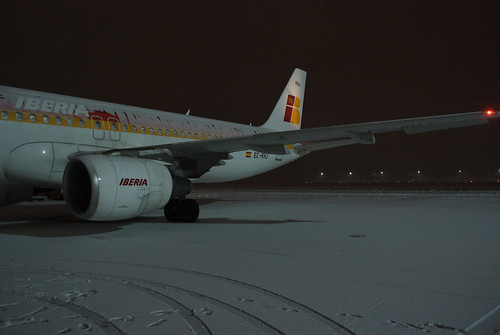
Hace unas semanas recibí un comentario en este blog de una persona interesada en comprarme esta foto. La verdad es que me extrañó un poco porque no es la “mejor” foto que he publicado pero, bueno, parecía que tenía interés. Mi primera pregunta ante ese interés fue: “¿Para qué la quieres?”. La curiosidad me podía, y las ganas de que alguien usara mi foto para algo, más.
Imaginaos mi sorpresa cuando me dijeron que era para usar como decorado en una película y que, además, quería un precio para
“todos los medios, todos los territorios, a perpetuidad”
Vaya, parece que van en serio y encima piden un precio… ¿Y qué precio les digo?
Ante esta situación, en la que parece haber un interés real y no sabes si hay competidores con otras fotos, o no; lo primero que al fotógrafo aficionado como yo se le ocurre es “véndela por lo que sea, pero que salga en la peli”. Pero luego la parte negociadora del cerebro se activa, y empieza el juego: preguntas a otros fotógrafos a ver si sabían qué precio se les podía dar a esta gente, consulta de un PDF con precios para prensa escrita, … Pero nada se ajustaba a lo que me pedían los de la productora de cine: “todos los medios, todos los territorios, a perpetuidad”.
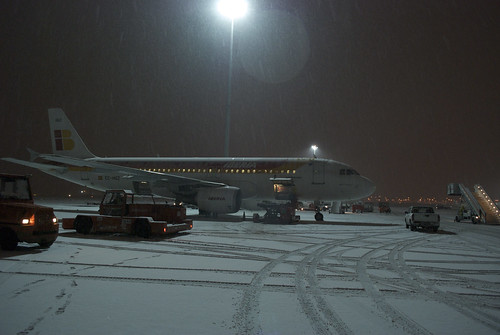
Agotada una de las partes (los fotógrafos) tocaba informarse desde el lado contrario: las productoras de cine. Así que tiramos de contactos otra vez para llegar a productores de cine y televisión que me pudieran decir cuál era el “precio de mercado” en estos menesteres.
En este momento, tu cabeza ya no piensa en vender la foto como sea (incluso regalada), como al principio. Ahora lo único que no quieres es “mal venderla”, pero sin pasarte para conseguir tu minuto de fama en la película, claro está. Esta forma de actuar me recordaba bastante a la especulación de la burbuja inmobiliaria. Yo sé que vendiendo la foto por algo, es más de lo que saco si no la vendo, pero también sé que a otros se la compran por más dinero… Así que a maximizar los posibles ingresos.
Bueno, si la información de los fotógrafos me indicaba 50-100 euros (precios normales para periódicos y con derechos restringidos), la primera información que me llegó desde una productora de televisión hablaba de “desde 3000 euros para arriba”. Mis ojos eran como los del Tío Gilito, con $$ en las pupilas: ¿¿3000 euros?? Había que aplicar algún factor de corrección a esta cifra porque esa productora compra fotos de famosos generalmente y, ¿claro?, esas fotos se pagan mejor (así nos va). Además, la segunda productora, más cercana al cine que la primera, me sugirió “entre 100 y 1000 euros”, aplicando ella ya el factor de corrección por mi prestigio nulo en el mundo de la fotografía.
De 3000 euros había bajado a unos cuantos cientos los posibles ingresos… Pero bueno, tampoco estaba mal. Ya estaba en disposición de responder a la productora, a la que le había mandado una serie de 5 fotos para que me dijera cuál/cuáles quería… Y la respuesta, después del subidón de adrenalina buscando información de precios, fue “no nos interesa ninguna, queremos una vista de un aeropuerto nevado por la noche y con más aviones… más general”. Mi gozo en un pozo.
Al menos la experiencia me ha servido para la próxima.
“Tengo fotooooos… ¿Alguien quiere foooooootos? ¡¡Fotos a precio de mercado!! ¡Me las quitan de las manos!”