


During the traditional summer BBQ organised by my friend Javi, we agreed that the time for a new visit to Toulouse had arrived. This time it would include a new ingredient that the previous ones did not have: flying with him as a pilot. I like Toulouse, I like its food, several friends are also there, and flying for the first time in a small aircraft added an extra dose of adrenaline to the cocktail.
The adventure started a few days before my arrival to Toulouse. Javier sent me an e-mail with some options, with a message: “You will need to choose what to fly over, if the meteo allows it”. Inside, several options with pros and cons. We finally decided to go for a route he already made several times: flying to Auch, where we would have lunch, and then flying back. The main drivers for selecting this was obviously that taking a plane to go for lunch is quite a cool statement, plus it included the possibility to fly over Toulouse-Blagnac airport, and at least two take-offs and landings. It is important to remind here that Toulouse is home of the Headquarters of Airbus, as well, as the Final Assembly Line (FAL) of several of their models…
First thing we had to do (although that was done already for the previous time) was the Flight Plan. (Note this post uses the plural as a literary resource… the truth is that most of the “we” should be Javi, i.e. the pilot). That is, tracing the route you want to follow on the chart, plus writing the different tracks in a sheet of paper for the pilot’s convenience.
Once we arrived to the aerodrome, there were a number of checklists to be completed by all pilots to ensure everything is as it should be before the next step. There is a checklist before jumping into the plane, one before starting the motor, another one before entering into the runway… These checklists were followed by Javi to the word, and it is done today in every single flight too. Safety first is more than a nice thing to say when talking about machines that fly.
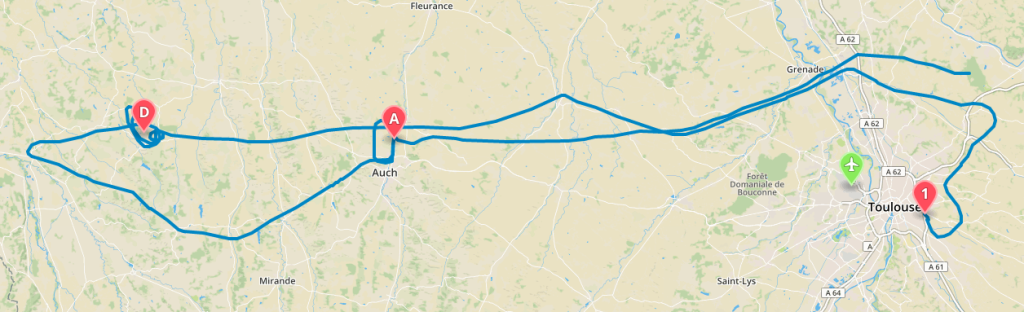
After refuelling, and the several checklist had been completed, we finally took off from Lasbordes Aerodrome (1) in F-GTPK, DR44. I must admit the first couple of minutes were not easy for me. I believe the adrenaline was not flowing enough to cope with the feelings with the first turn… But these took just a three minutes, then we started navigating which was fun (and I started the GPS tracker!). We requested permission to the controllers to cross the airport… which they denied, as there was commercial traffic at that moment, so we took a detour around Toulouse to be able to arrive to Such. This was a challenging part as we had to find a new checkpoint following the controllers indications and alter the original route.
Navigation up there is quite an interesting topic. These aircrafts do not have a visual GPS software to help the pilot, but quite sophisticated, but analog instruments plus a key tool: your eyes… That is why the pilot is entitled to fly “visual”. Navigation is all about having a chart in paper, and recognising the different elements (a town, a road, a mountain, a river, …) on the ground… once you find one of them, you trace a line to your destination, decide the heading and use some analog devices to follow the desired track. This is a challenging task. It is not easy to confirm that certain small town is indeed the one you are looking for, and it takes some time flying over an area to recognise them at first sight those points.
You can imagine how useful controllers are in these situations. They can help you find your way if you do not manage to do it yourself, and they provide traffic information in your route to make it a more pleasant journey. In the end, you are moving at 200 km/h and flying for a few minutes in the wrong direction can lead to a messy situation. Controllers are in charge of different zones, and when you cross from one to another, you shall change your radio to the new station, say hi, and they normally give you a code to tune your transponder. Now they can “see” you in the radar…
Once we managed to find the new route, it did not take us long to arrive to Auch aerodrome (A). This aerodrome has no control tower, so you have to do everything by yourself… like identifying which is the most appropriate pathway to use by checking the predominant wind direction or announcing by radio our intentions. Landing was softer than I expected (although adrenaline was also there landing with us), we parked the plane, and had lunch at Jean-Philippe’s restaurant with views to the aerodrome and our plane.
After lunch, it was time to continue our route through the Gers region to sight some castles. In this case, we had a particular goal to find Lupiac (D), also known as D’Artagnan’s town, as it hosts the two castles where the real D’Artagnan was born (Castelmore) and lived (La Plagne). We succeeded thanks to Javi’s previous work in Google Maps, and in the field (he had been in Lupiac before), and started our route back to Toulouse, with the only surprise of a couple of gliding aircrafts flying at the same altitude than us. When we arrived to Toulouse-Blagned, we were denied crossing it again, this time due to some photo shooting taking place, so we surrounded it, and landed in Lasbordes again… safely.

In one of my visits to Strasbourg, we visited the Ligne Maginot. This is a line of hidden fortifications, that France built after the World War I in order to protect the country from a potential attack from Germany, especially in what referred to Lorraine and Alsace, two regions that have changed nationality several times in the history.

This defines line was made up of 45 main forts, and 97 smaller ones, and pursued several specific goals: serve as early alarm, hide the mobilisation of the French army, and protect the country in case of an attack through that border.

The mentioned forts consisted of underground bunkers, where the soldiers lived, waiting for an attack. Its construction employed a 25% of the whole country budget, between 1930 and 1935, and was made of the highest quality, with plenty of electrical appliances.


We visited one of these forts, and could imagine the life there. 580 men, called themselves, crew, as life in those forts was more similar to a submarine than a “regular” fort. This fort had 6 towers on the surface to attack (with guns) and to surveil, and more than 500 meters of underground tunnels. Other forts had several km of tunnels, though.

In the end, this line did not prevent the invasion of France, as Germany took the “long way” through the Netherlands and Belgium, and France could not check the effectiveness of such a large investment.
[AFG_gallery id=’15’]
Strasbourg is a French city, hosting the European Parlament, next to the Rhine river, and being a border city with Germany (is border still a valid word in the EU?). The region where it lies (Alsace) has been changing hands from the French to the Germans, and vice versa since the Romans were around. The last exchange took place in the beginning of the 20th Century, so not that long ago.


This is why Strasbourg was chosen as the host city for the European Parliament: this region has lived more wars (can you live a war? isn’t that totally impossible?) than any other region in the continent, and is therefore a perfect example of what EU is all about (in its origin: peace).


In fact, both sides of the Rhine have a massive park linked by a bridge to show this unification spirit.

Walking in the city you will notice examples proving this is one of the cities with the highest income in France: everything is clean, in perfect conservation state, and parks are full of attractions for the children and some grown-up. If you woke up in the beautiful small city centre, you would think you are in a German town for several reasons: the architecture cannot hide the German influence, it is crowded with German tourists, and even the dishes you can see in the restaurants are very similar to the food on the other side of the Rhine: Riesling wine, choucroute, flammkuchen, …


You can also find some additional signs of old installations that make a German speaking time clear.

One of the best things of this region is, without any kind of doubt, their white wine. Names as Riesling or Gewurzträminer varieties are well known for anyone who is properly advised in the wine world. There is a wine route well organized going south from Strasbourg, where you can stay as many days as you can while visiting the vineyards and tasting the different ones. We took only a part of it, and visited Obernai, where we had the opportunity to taste several wines, buy some, and have a walk around the vineyards.


If you want to take a deeper look to these cities, check the following slideshows: Strasbourg and Obernai
I spent the second half of my September holidays visiting a friend living in Toulouse. It has been my second visit to the “Ville Rose” after the seminar which took me there in 2006, and I consider it an interesting place to visit, as it has not only the city (which is already quite nice), but also many interesting places relative near, allowing nice daytrips to get some variety. I devoted one full day to revisit the city, and we did a couple of trips on Saturday and Sunday (in the next post).


I do not know what you think, but a city with a river has automatically a couple of extra points in beauty and attractiveness than one without it… and Toulouse is not an exception. If you add to that well preserved buildings from their roman and medieval times, a very young and international population (attracted by a number of universities and important companies (Toulouse is by far one of the most important cities in the world for the aerospace industry)), and the famous cuisine… Perfect destination.


As usual, some more picture from Toulouse in this slideshow.
Long weekend in Spain, and a pending invitation to visit Paris. I was there a couple of years ago, but Paris is always nice to revisit. In fact, revisiting was the perfect plan for this trip, as I wanted to take it easy. So, a lot of walking around this beautiful city, getting some insider’s tips and information about life in there, and enjoying the French cuisine at an affordable price.

Of course, the walking included all the typical spots…


… and also meetups with some friends living or visiting the city, making a good usage of the Parisian terraces. I like the fact that they are intended to make customers look to the rest of pedestrians, instead of the people sitting with them.

