


Korea is different. Here you are a list of things that I lived during my last stay in Korea, and which are not common in some other parts of the world:


If you think all weddings are the same… you have not been to a wedding abroad. Weddings are one of those events where local culture plays an important role. In Spain, I am used to the church/townhall+quiet dinner+drinks+dance weddings. There are always some differences among the different weddings, but the format is pretty much the same.
Well, the Bulgarian wedding I attended was not the same. First, the actual marriage ceremony was a combination of symbols I knew (the rings, the wine, …) with some new ones: a white carpet to walk in, a flower arch to go through, or the bread the bride and the groom had to split in two parts… and the one who kept the bigger portion was meant to provide the main economical sustenance. During the ceremony, there was a traditional folk group singing and playing, as well as some traditional dancing.
Then, we moved on to the dinner part… and it also starts differently. We picked a champagne glass and we queued to go in, and toasted with the bride, the groom and the respective parents, as well as giving them the presents and some flowers for the bride. After that, there was another ceremony, with some more new symbols for me. One of them consisted in breaking a glass in hundreds of pieces… According to the speaker, each piece meant a child… no pressure.
After all guests, bride and groom sat down, we started with the dinner… but not for a long period of time. After 15 minutes, we were all up dancing хоро (the traditional Bulgarian dance), and after that we could sit down to continue with our dinner… until we had to dance again, either хоро or any other music…
If we were not on the dancefloor, it was not empty… there was always some entertainment going on. Either some kind of theatre involving the bestman, bestwoman and best friends, or some traditional dancing (see video), belly dancing (!) or speeches…
A last difference: while in Spanish weddings, guests are often quite direct to make the bride and the groom by shouting “Que se besen!” (kiss!). In Bulgaria, they do have the same act of shouting something to make them kiss, but there is more symbolism on it. There, they say “горчив” (Gorchivo), which means “bitter”, and hence they kiss to make it sweeter. Quite nicer.
Auf Deutsch am Ende der Post.
Hoy es Himmelfahrt en Alemania, más conocido como Ascensión en castellano. Bueno, el caso es que hoy es fiesta, y además, en Alemania, se celebra el día del padre. Hasta ahí todo correcto. Además, resulta que la celebración se ha extendido a algo parecido a día del hombre (sea o no padre). Hasta aquí también es entendible. Ahora viene lo particular. Este día generalmente los hombres (jóvenes y no tan jóvenes) se van con los amigos a pasar el día por ahí (bosques, parques, y similares no les faltan) y con una buena cantidad de cerveza (y no sólo cerveza) y… ancha es castilla.

Pero la cosa no queda ahí: en Hannover se celebra la Bierlauf. Tan magno acontecimiento consiste en una carrera (corriendo) por equipos de tres personas, que deben de portar una caja de cerveza con 24 botellines. No contentos con esto, hay un par de normas más: los botellines al principio de la carrera deben de estar llenos y, al final, vacíos porque los componentes del equipo deben haberse bebido la cerveza. Aquí hay algunos momentos de la salida:


Muchos pensaréis, sobre todo después de ver la foto anterior, que la gente no correrá. Pues os equivocáis, el circuito de la carrera consiste en dar una vuelta completa al Maschsee (unos 6-7 kilómetros), y la dan, cargados con las cervezas y con una media de 8 cervezas por cabeza en unos 30 minutos. Aquí hay una imagen de la llegada:

Luego, nos hemos pasado por la plaza del Ayuntamiento porque había un festival de Jazz. Había también mucha gente y buen ambiente. En Hannover, a partir de abril, casi todos los fines de semana y días festivos hay algún evento que congrega a mucha gente a su alrededor. De hecho, a continuación, hemos estado en el parque que está cerca de la universidad porque había una competición de bolos, que va a estar hasta finales de la semana que viene, y que alrededor habían puesto bancos y una barra para tomar algo.
Por cierto, que si en el post anterior os comentábamos que hacía calor, nos desdecimos, ahora hace frío:

Aquí tenéis fotos del día de hoy.
Hallo! Heute war ein sehr kalter Feiertag (Himmelfarht) und wir sind am Maschsee gewessen. Dort gab es einen interessanten Lauf: den Bierlauf. Mannschaften von drei Personen sollten mit einem Bierkasten laufen, und am Ende, sollten alle Flaschen leer sein. Es war lustig weil manche Leute komische Klamotten tragte und sie waren ein bisschen betrunken.
Wir haben Photos von der Start (das zweite, dritte und vierte), und von das Ziel (das fünfte).
Für uns ist es eine besonderes Sitte, dass am Vaters Tag jeder Mann mit Freunde (nur männliche Freunde) saufen soll.
Wie gesagt, heute war ein sehr kalter Tag obwohl es schon Mai ist. Das letzte photo ist nur ein Beweis.
Mehr Fotos von diesem Tag: hier.
Unas pocas líneas para comentar algunas tradiciones de la Pascua en Alemania. La Semana Santa en Alemania tiene un carácter mucho más familiar que en España y es un momento en el que todos los estudiantes vuelven a sus casas, como en Navidad, aunque un poco menos importante.
Una tradición típica de Pascua es el Osternhase o Conejo de Pascua. Por toda Alemania hay conejos que van dejando huevos de pascua (huevos duros pintados de colores) y huevos de chocolate, las familias y amigos se esconden regalos por los jardines y luego los buscan. Es muy típico. En una plaza de Hannover se podían ver en un mini-jardín estos conejos con varios huevos, además de un enorme huevo rosa.
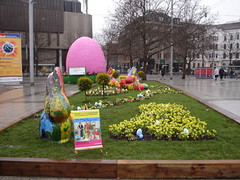
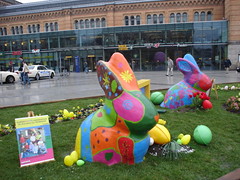
Por otro lado, el sábado por la noche, se hacen unas hogueras con un aire al estilo de la Noche de San Juan (pero sin bañarse, claro está) y con la misma motivación que las Fallas: renovación. En algunos lugares, como en Karlsruhe, parece que están asociadas a las celebraciones religiosas; aunque en Hannover son celebraciones totalmente paganas.